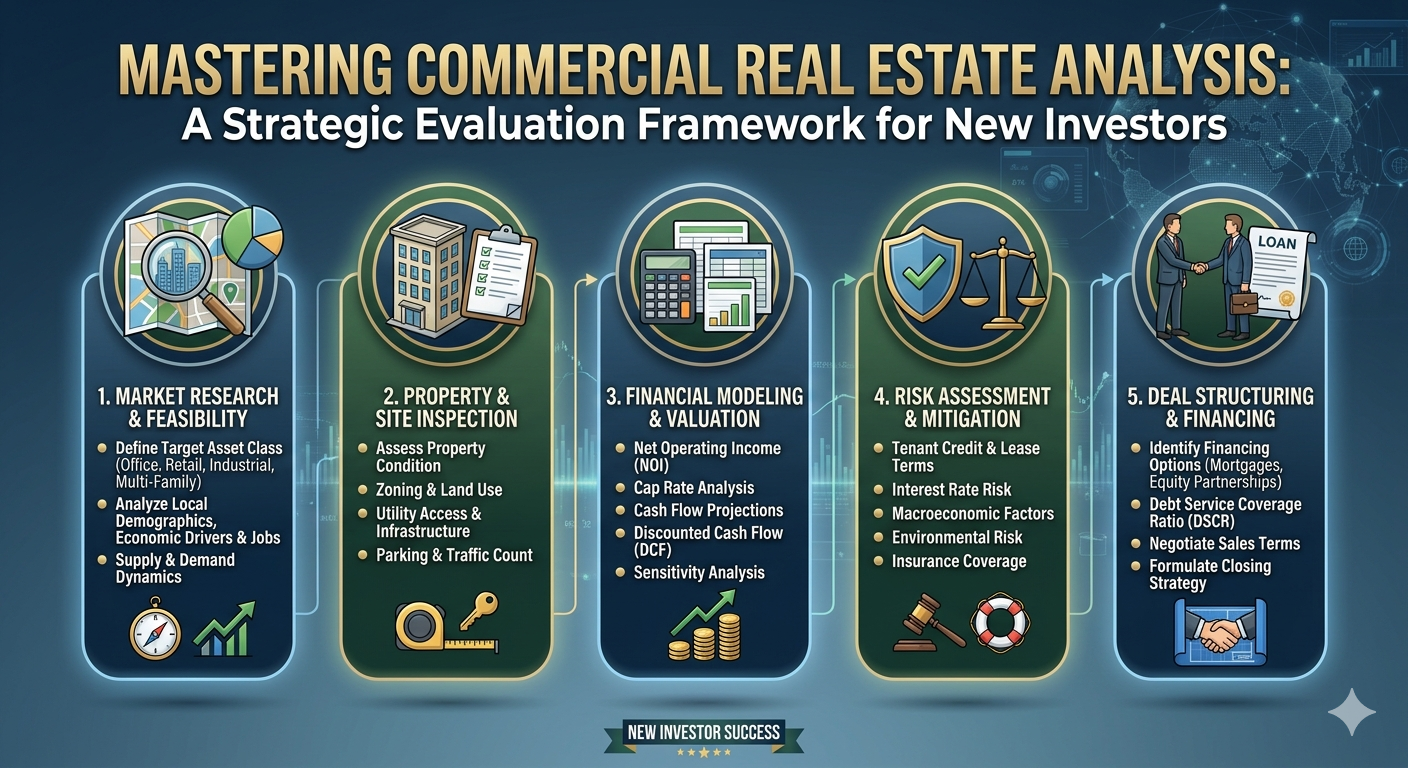
Entering the commercial real estate arena in May 2026 requires more than just capital; it demands a sophisticated strategic evaluation framework that accounts for a rapidly shifting economic and regulatory landscape. As we stand at this unique inflection point, the era of easy appreciation driven by rock-bottom rates has been replaced by a “constructive phase” where income and operating fundamentals are the primary drivers of value. For new investors, mastering commercial real estate analysis today means looking beyond the physical asset to understand the complex interplay of hawkish monetary policy, new transparency requirements, and sector-specific demand spikes fueled by the ongoing artificial intelligence boom.
A robust evaluation begins with a granular look at market fundamentals, which in 2026 are increasingly defined by selectivity. While the broader market is “turning the corner,” success is found in submarkets with deep talent pools and industry clusters. For instance, tech hubs like San Francisco and San Jose are seeing a resurgence in multifamily rent growth as AI firms mandate in-person collaboration, while the Midwest offers stable, defensive income opportunities. When evaluating a property, you must analyze the “Weighted Average Lease Term” (WALT) and the quality of the tenant’s business model. In a climate where the Federal Reserve, now under the leadership of Chair Kevin Warsh, has held interest rates steady between 3.5% and 3.75% but signals a potential hike by year-end, your underwriting must be conservative. New investors should stress-test their debt service coverage ratios against a 4% or 4.5% interest rate environment to ensure the asset remains viable even if the Fed moves to lean against war-induced inflation pressures.
The second pillar of your framework must be a deep dive into the financial underwriting, specifically focusing on “price discovery.” We are currently seeing a realignment where pricing and return expectations are finally matching the reality of higher-for-longer borrowing costs. This means your analysis should prioritize Net Operating Income (NOI) growth over speculative exit caps. High-conviction sectors for 2026 include data centers—driven by massive AI workloads—and medical offices, which benefit from an aging demographic and a lack of new supply. Conversely, the “21st Century ROAD to Housing Act,” which passed the House on May 20, 2026, has created a new competitive dynamic. By restricting large institutional investors from purchasing existing single-family homes, the act is inadvertently pushing more institutional capital toward new builds and multifamily developments. As a new investor, you must evaluate how this influx of institutional competition in the multifamily space might compress your margins or, conversely, provide a clear exit strategy if you are developing or stabilizing smaller assets.
Beyond the numbers, the 2026 regulatory environment introduces new compliance hurdles that must be integrated into your due diligence. The FinCEN Residential Real Estate Reporting Rule, which went into effect on March 1, 2026, is a critical consideration for those using LLCs or trusts for all-cash acquisitions. This rule effectively ends anonymity for many non-financed transfers, requiring detailed federal reports on the beneficial owners behind the deal. While this primarily targets residential assets, many mixed-use and small-scale commercial properties fall under its umbrella. Furthermore, the “One Big Beautiful Bill Act” (OBBBA) has fortunately preserved the 1031 exchange in its current form, allowing you to continue deferring capital gains taxes. However, the stakes for compliance are higher than ever; missing the 45-day identification window or the 180-day closing deadline in this active market can trigger immediate tax liabilities that could derail a growing portfolio.
Finally, a strategic evaluation is incomplete without considering the “retailization” of private capital. Recent executive orders have made it easier to include alternative assets like commercial real estate in 401(k) plans, and the SEC has opened doors for retail investors to access private equity and credit through registered fund vehicles. This means more liquidity is entering the market from non-traditional sources, potentially stabilizing valuations even in the face of interest rate uncertainty. As you build your framework, remember that commercial real estate in 2026 is a marathon of disciplined underwriting and regulatory agility. By focusing on assets with strong operational fundamentals, staying ahead of FinCEN reporting requirements, and maintaining a hawkish eye on the Fed’s next move, you can navigate this “new dawn” of real estate with the confidence of a seasoned professional. Success today is not about the speed of the transaction, but the depth of the analysis.
Leave a Reply