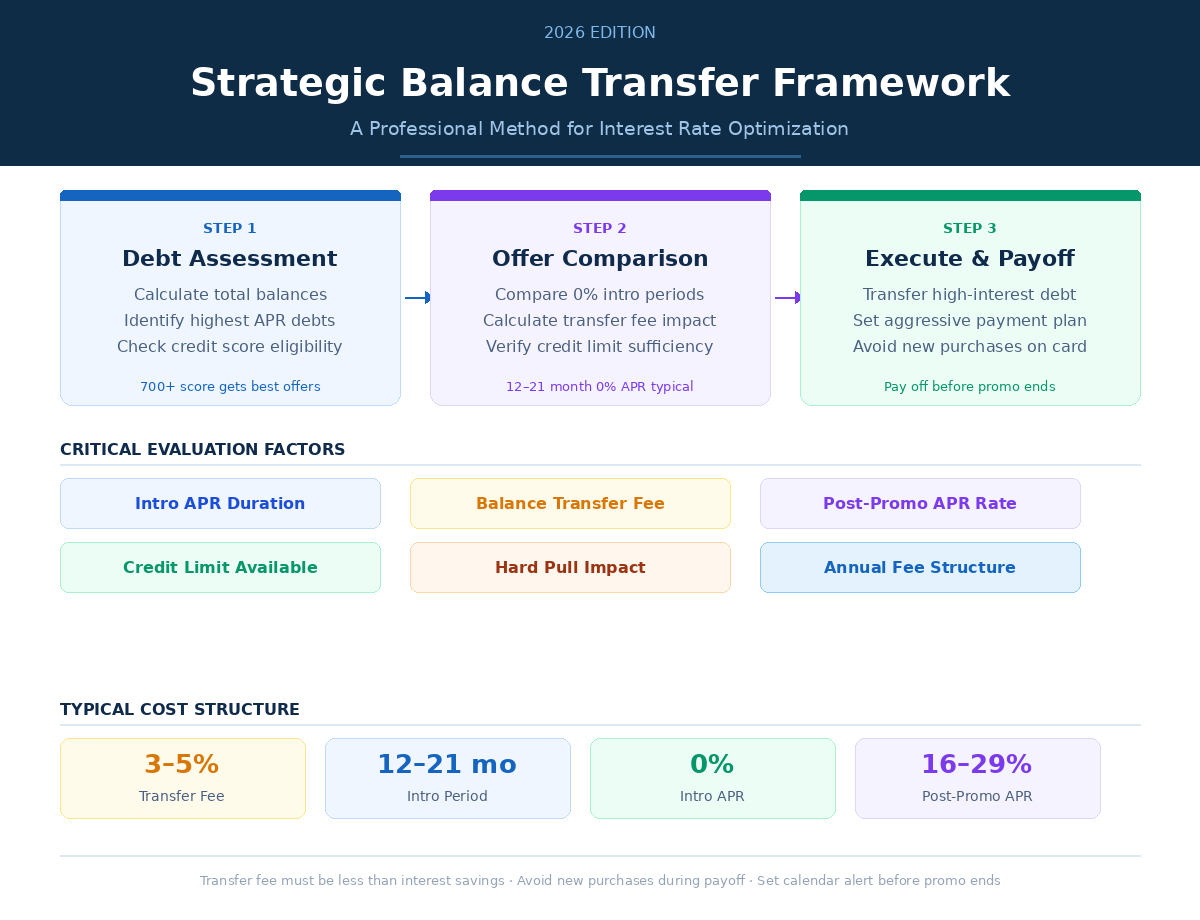
In the current American economic landscape of May 2026, the cost of carrying consumer debt has reached a critical inflection point. With the average credit card APR for new offers climbing to a staggering 23.79% this month, many professionals find their monthly cash flow increasingly eroded by interest charges that far outpace traditional investment returns. This surge in rates follows a period of heightened volatility at the Federal Reserve, where the federal funds rate currently sits between 3.5% and 3.75%. While the market recently anticipated a period of easing, the latest FOMC minutes reveal a hawkish shift under the incoming leadership of Kevin Warsh, as persistent inflation—exacerbated by global energy shocks—has forced policymakers to signal that further rate hikes remain on the table. In this high-stakes environment, the Strategic Balance Transfer Framework is no longer just a debt management tool; it is a professional method for interest rate optimization that can save thousands of dollars in a single fiscal year.
The framework begins with a rigorous audit of your current liability portfolio. In an era where the average interest rate on accounts actually accruing interest is hovering around 21.52%, the first step is to identify any revolving balance with an APR exceeding 18%. This is the threshold where the mathematical benefit of a transfer typically outweighs the associated costs. Once these high-interest targets are identified, the strategy shifts to the selection of a high-performance transfer vehicle. As of May 2026, the market remains competitive for those with excellent credit, with top-tier offers like the Wells Fargo Reflect® Card and the Citi® Diamond Preferred® Card offering 0% introductory APR periods for up to 21 months. These extended windows are vital, as they provide nearly two years of interest-free runway to aggressively pay down principal while the broader market braces for potential rate increases.
However, a professional execution of this framework requires a precise calculation of the “break-even” point. Most leading issuers currently charge a balance transfer fee ranging from 3% to 5%. For a $10,000 balance, a 5% fee adds $500 to the total debt immediately. While this may seem substantial, a quick comparison against a 23.79% APR reveals that the fee is often recouped in less than three months of interest savings. The strategic advantage lies in the fact that every dollar paid after that break-even point goes directly toward the principal, effectively creating a self-funded deleveraging engine. It is also important to note the shifting regulatory environment; the Consumer Financial Protection Bureau (CFPB) recently finalized a significant rewrite of Regulation B, effective July 2026, which narrows the scope of certain fair lending protections. This shift underscores the importance of acting while credit availability for high-limit transfer cards remains robust, as future eligibility criteria may become more stringent under the new “intent-only” discrimination standards.
The maintenance phase of the framework is where many individuals falter, yet it is the most critical for long-term optimization. A professional approach dictates that the new card should never be used for new purchases during the introductory period. Because of how payments are allocated under the Truth in Lending Act (Regulation Z), adding new 23% APR purchases to a 0% transfer balance can create a “interest trap” that complicates the repayment schedule. Instead, the framework utilizes an automated “accelerated amortization” schedule. By dividing the total transferred balance by the number of months in the introductory period—minus one month for a safety margin—you create a fixed monthly payment that guarantees a zero balance before the high variable rates kick back in. For example, a $10,000 transfer on a 21-month card should be repaid at approximately $500 per month to ensure the debt is extinguished by month 20.
Finally, one must consider the impact on credit optics. While opening a new account and increasing credit utilization on a single card can cause a temporary dip in your credit score, the long-term reduction in total debt and the improvement in debt-to-income ratios typically result in a net positive outcome. In a 2026 economy where the “One Big Beautiful Act” has already begun to reshape the fiscal landscape, maintaining a high credit score is essential for accessing the best financial products. By treating a balance transfer as a strategic interest rate swap rather than a temporary fix, you position yourself to navigate the current hawkish Fed cycle with minimal exposure to the rising cost of capital. This framework is not merely about moving debt; it is about reclaiming the “interest spread” for your own net worth, transforming a monthly liability into a structured path toward financial sovereignty.
Leave a Reply