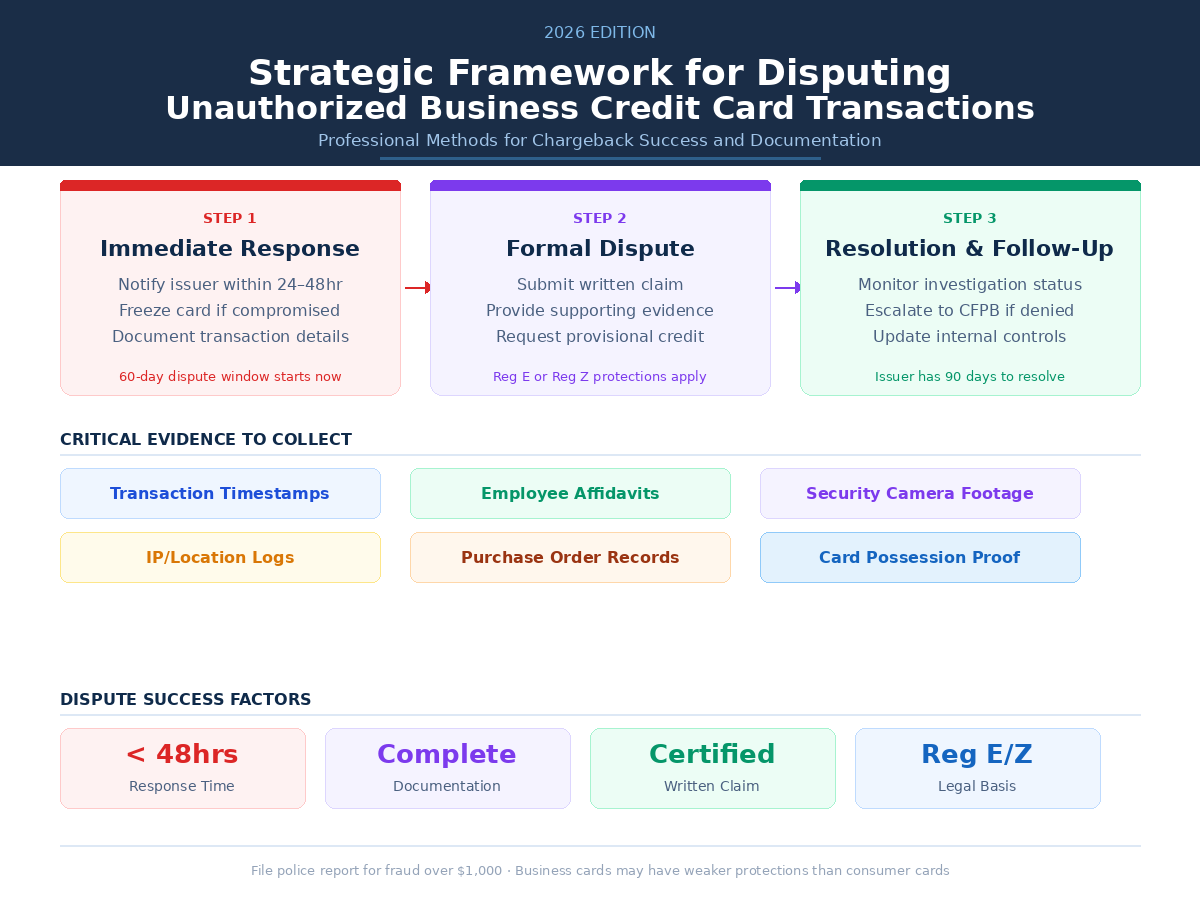
In the fast-evolving financial landscape of 2026, protecting your company’s bottom line requires more than just a passing glance at monthly statements. As of May 21, 2026, the strategic framework for disputing unauthorized business credit card transactions has shifted from a reactive chore to a high-stakes operational priority. With the recent implementation of the Visa Acquirer Monitoring Program (VAMP) and tightened Mastercard dispute windows, the margin for error has effectively vanished. For U.S. business owners, understanding that business credit cards do not share the same ironclad federal protections as consumer cards is the first step in building a resilient defense. While the Fair Credit Billing Act (FCBA) famously caps consumer liability at $50, business accounts often operate under a “contractual liability” model where the fine print of your issuer agreement dictates your exposure.
A robust strategic framework begins with the “Golden 48” rule. In 2026, the speed of reporting is the single most significant factor in a successful dispute. Major networks have drastically shortened merchant response times—sometimes to as little as nine days—which means your issuer needs your data immediately to meet these aggressive network deadlines. If you fail to report an unauthorized charge within the first 48 hours of its appearance, you risk being flagged for “gross negligence,” a term that issuers increasingly use to bypass Zero Liability policies. This is particularly critical for small businesses where a personal guarantee is attached to the account; an unsuccessful dispute doesn’t just hurt the company’s cash flow—it can directly impact your personal credit score and assets.
The second pillar of your framework is the “Evidence-First” audit. Before picking up the phone, you must distinguish between true fraud—such as a cloned card or a database breach—and “friendly fraud,” which often stems from employee misuse or unrecognized recurring subscriptions. In 2026, AI-driven billing descriptors have become more complex, and a charge that looks like a string of gibberish might actually be a legitimate SaaS renewal. Use real-time spend management tools to cross-reference the transaction against your internal digital receipt repository. If the charge is indeed unauthorized, your dispute package should include the transaction ID, the specific network reason code (such as Visa’s 10.4 for Other Fraud), and a formal declaration that the card was in your possession at the time of the charge.
Navigating the 2026 regulatory environment also requires a keen eye on the “Inquiry Stage.” American Express, for instance, has maintained its strict 20-day response window but often initiates a preliminary “inquiry” before a formal chargeback is filed. This is your strategic window to resolve the issue without escalating to a full-blown dispute, which can carry heavy administrative fees. During this stage, transparency is your best asset. Provide your issuer with a clear narrative of why the charge is invalid, backed by your company’s written spending policy. This demonstrates to the bank that you maintain “commercially reasonable” internal controls—a standard that has become a benchmark for liability shifts under the latest NACHA and CFPB guidance.
Furthermore, the strategic framework must account for the “Liability Shift” nuances of EMV technology. If an unauthorized in-person transaction occurred because your business failed to use a chip-enabled terminal or an updated mobile wallet reader, the liability may automatically rest on your shoulders regardless of the fraud’s origin. This makes hardware compliance a core component of your dispute strategy. For remote or “card-not-present” transactions, which now account for the vast majority of business fraud in 2026, the use of virtual cards with merchant-specific locks is the ultimate preemptive strike. By assigning a unique virtual card to every vendor, you can instantly trace an unauthorized charge to its source, providing “smoking gun” evidence that simplifies the dispute process.
Finally, remember that a dispute is a formal negotiation, not just a complaint. Once you file, monitor your account for a “provisional credit.” Under 2026 protocols, banks are faster to issue these credits but equally fast to reverse them if the merchant provides “compelling evidence” of a valid sale. Stay engaged throughout the 60-to-90-day investigation period. If your dispute is denied, don’t hesitate to request the “Documentary Evidence” the merchant provided. In the current climate, many disputes are won on the second attempt—known as pre-arbitration—by pointing out inconsistencies in the merchant’s rebuttal. By treating every unauthorized charge as a data-driven challenge rather than a financial loss, you position your business to thrive in an era where digital security is the new currency of trust.
Leave a Reply