As of May 21, 2026, the American financial landscape is navigating a complex intersection of geopolitical tension and persistent inflationary pressure. With the annual inflation rate recently accelerating to 3.8%—driven largely by energy spikes following the ongoing conflict in the Middle East—the Federal Reserve has maintained a steady but increasingly hawkish stance. Currently, the federal funds rate sits between 3.5% and 3.75%, but recent FOMC minutes suggest that the era of “easy money” is far from returning. For US savers, this environment creates a unique “hawkish hold” scenario where the choice between a High-Yield Savings Account (HYSA) and a Certificate of Deposit (CD) is no longer just about interest rates, but about strategic positioning against a volatile economic backdrop.
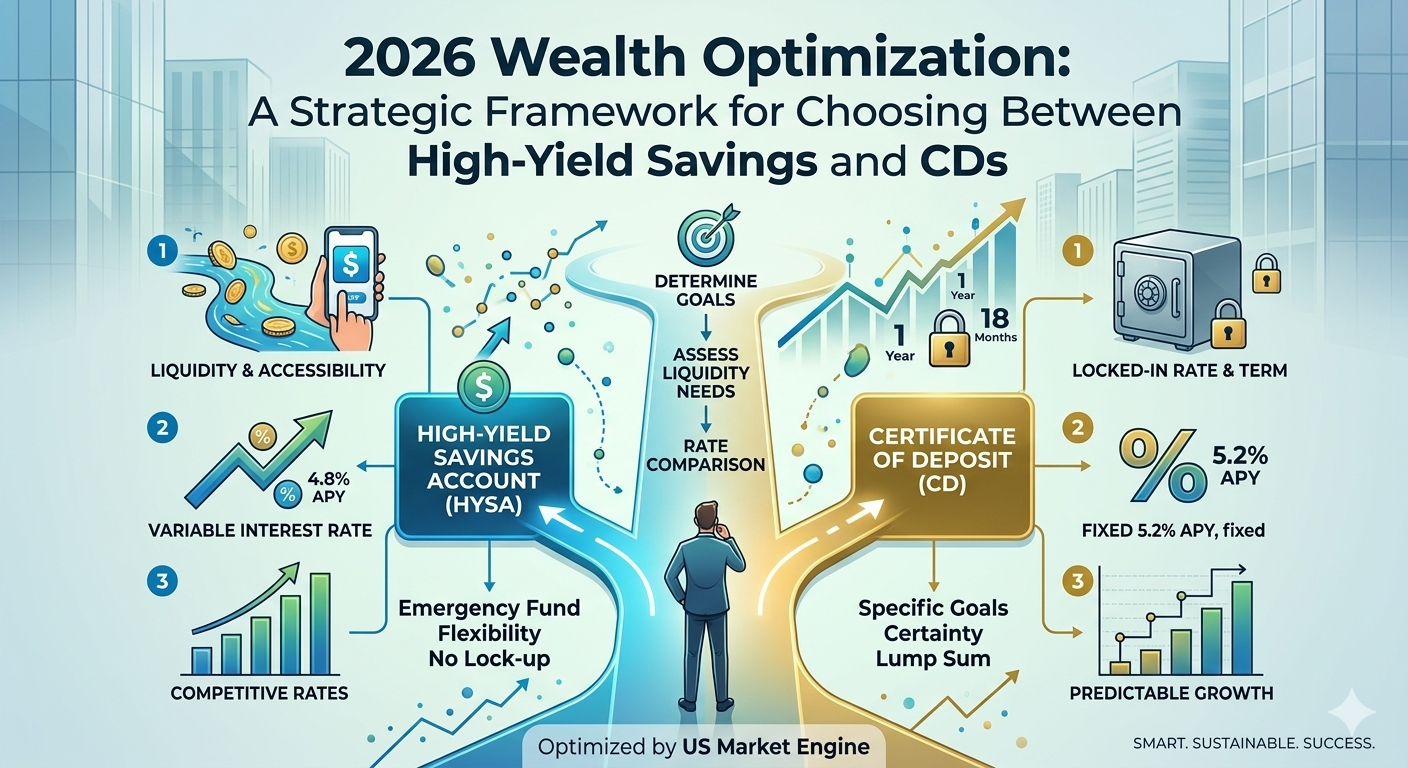
Wealth optimization in 2026 requires a framework that prioritizes “real returns”—the yield you earn after accounting for that 3.8% inflation. Currently, top-tier HYSAs are offering yields around 4.10% to 4.16%, providing a slim but vital margin of growth above the rising cost of living. The primary advantage of the HYSA in today’s market is its agility. Thanks to the newly implemented Personal Financial Data Rights Rule, which took full effect earlier this year, the friction of moving money between institutions has vanished. This “Open Banking” era allows you to jump to a higher-yielding competitor in minutes, ensuring your emergency fund or short-term cash isn’t stagnating in a legacy account while the Fed debates its next move. If you value liquidity and want the ability to pivot should the Fed decide to hike rates further this summer, the HYSA remains your most potent tool.
However, the CD market is currently presenting a compelling “lock-in” opportunity that hasn’t been this attractive in years. We are seeing a notable inversion where short-term CDs are outperforming their long-term counterparts. For instance, 6-month jumbo CDs are hitting peaks as high as 4.94%, while 1-year terms are hovering around 4.10%. This suggests that while banks are hungry for immediate deposits to shore up their balance sheets, they expect rates to eventually cool by 2027. By choosing a 6-month or 1-year CD today, you are essentially “betting” that the Fed will either hold steady or that inflation will begin to moderate. You are locking in a guaranteed return that significantly outpaces current inflation, providing a safe harbor for capital that you don’t need for immediate expenses.
The strategic framework for choosing between these two depends on your view of the “War-Induced Inflation” cycle. If you believe the energy shocks from the Iran conflict will continue to push the Consumer Price Index higher, staying liquid in an HYSA allows you to capture the higher rates that would inevitably follow a Fed rate hike. Conversely, if you suspect the economy is nearing a tipping point where the Fed must eventually cut rates to prevent a recession—despite the current hawkish rhetoric—locking in a 4.9% yield on a short-term CD is a masterclass in wealth preservation. Many savvy investors are currently utilizing a “CD Ladder” strategy, splitting their cash between a liquid HYSA for immediate needs and staggered 6-month CDs to capture these peak yields without sacrificing total access to their capital.
Furthermore, it is important to be aware of the 2026 tightening of internal monitoring systems across major US banks. While the $10,000 reporting threshold remains the federal standard, banks are now utilizing more sophisticated AI-driven compliance tools to review large deposits and transfers. When moving significant sums to optimize your wealth, ensure your documentation is in order to avoid the “verification holds” that have become more common this spring. In this high-stakes environment, the winner isn’t necessarily the person with the highest APY, but the one who balances high-yield growth with the flexibility to adapt to a rapidly shifting global economy. Whether you choose the fluid nature of an HYSA or the guaranteed fortress of a CD, the key is to remain active; in 2026, the cost of financial inertia is higher than ever.
Leave a Reply