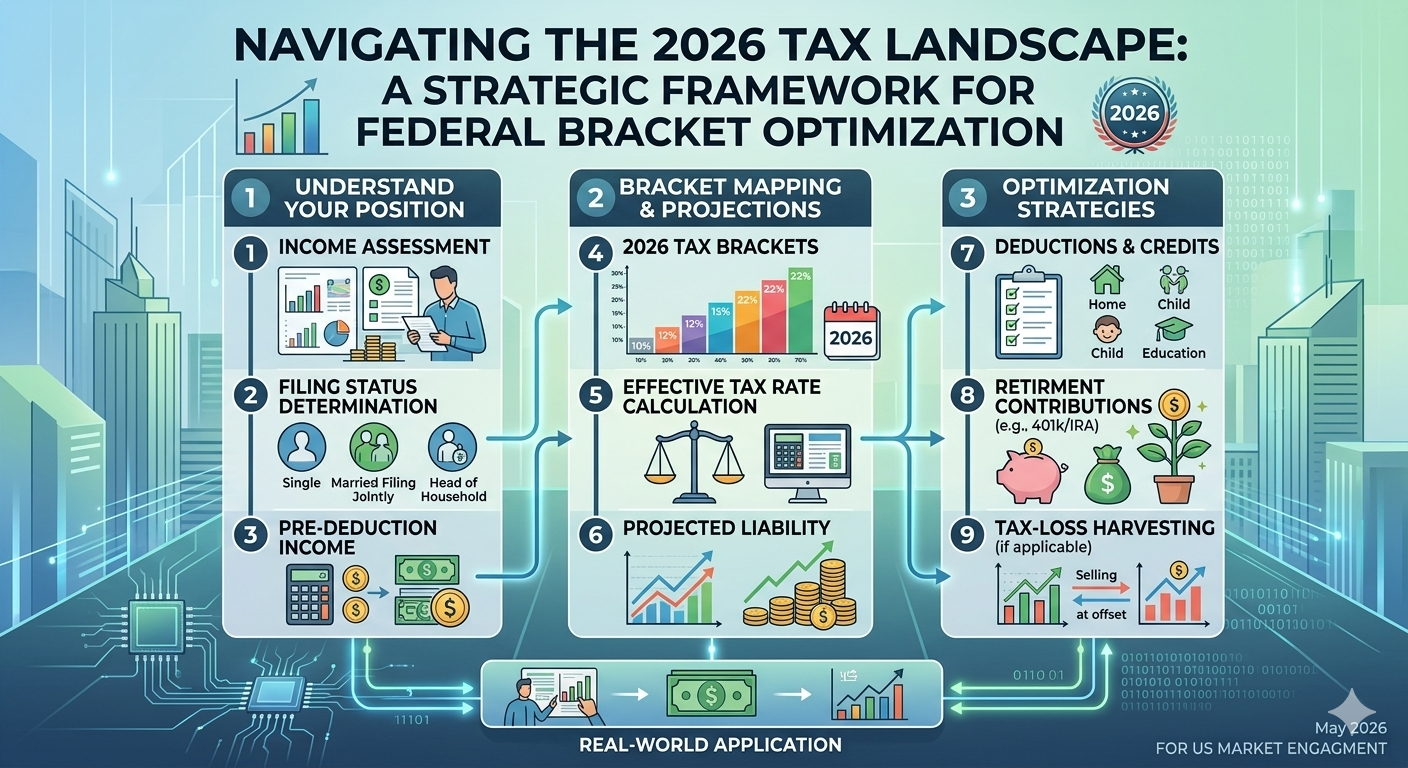
As we cross the midpoint of 2026, the American tax landscape has reached a pivotal state of clarity that few predicted just two years ago. For years, taxpayers and financial advisors lived under the shadow of the 2025 “sunset,” bracing for a return to the higher pre-2018 tax rates. However, with the passage and implementation of the One Big Beautiful Bill Act (OBBBA), the federal tax framework has undergone its most significant transformation in a generation. Navigating this new environment requires more than just compliance; it demands a strategic framework for federal bracket optimization that leverages the permanency of current rates alongside aggressive new deductions.
The most foundational shift in the 2026 tax year is the permanency of the seven-bracket structure. The 10%, 12%, 22%, 24%, 32%, 35%, and 37% rates are no longer temporary measures but the established law of the land. For high earners, the 37% top marginal rate now applies to taxable income exceeding $640,600 for single filers and $768,600 for married couples filing jointly. This permanency allows for long-term multi-year income shifting strategies that were previously too risky. Taxpayers can now confidently utilize Roth conversions and capital gain harvesting without the looming fear of a 39.6% top tier returning in the immediate future.
Optimization in 2026 also hinges on the significantly expanded standard deduction, which has risen to $16,100 for individuals and $32,200 for joint filers. However, the “standard versus itemized” debate has been reinvigorated by the OBBBA’s relief on the State and Local Tax (SALT) deduction. The previous $10,000 cap, which frustrated many in high-tax states for nearly a decade, has been raised to $40,400 for the 2026 tax year. This fourfold increase means that for many homeowners and professionals in states like California, New York, and New Jersey, itemizing has once again become the mathematically superior path. A strategic framework must now include a mid-year “SALT check” to ensure property tax payments and state estimated taxes are timed to maximize this expanded ceiling.
For the American workforce, 2026 introduces novel optimization levers through the “No Tax on Tips” and “No Tax on Overtime” provisions. Eligible taxpayers can now deduct up to $25,000 of cash tips and up to $12,500 of overtime pay from their taxable income, provided their modified adjusted gross income (MAGI) remains below the phase-out thresholds of $150,000 for individuals or $300,000 for joint filers. This creates a unique “bracket-within-a-bracket” where middle-income earners can effectively lower their effective tax rate by maximizing hours during peak periods without the traditional “bracket creep” penalty.
The 2026 landscape is particularly favorable for small business owners and the self-employed. The Section 199A Qualified Business Income (QBI) deduction, once scheduled to vanish, is now a permanent fixture of the tax code. Most pass-through entities can continue to deduct 20% of their qualified business income, and the OBBBA has even introduced a new $400 minimum QBI deduction for those with at least $1,000 in business earnings. With the phase-in thresholds for 2026 set at $201,750 for single filers and $403,500 for joint filers, business owners should focus on “income leveling”—using retirement contributions or equipment purchases to keep their taxable income below these thresholds to ensure the full 20% deduction remains unencumbered by W-2 wage limitations.
Older Americans have perhaps the most to gain from the 2026 strategic framework. Beyond the additional standard deduction for those over 65, a new senior-specific deduction allows for a reduction of up to $6,000 in taxable income (or $12,000 for couples). While this deduction phases out for those with a MAGI above $75,000 ($150,000 for
Leave a Reply