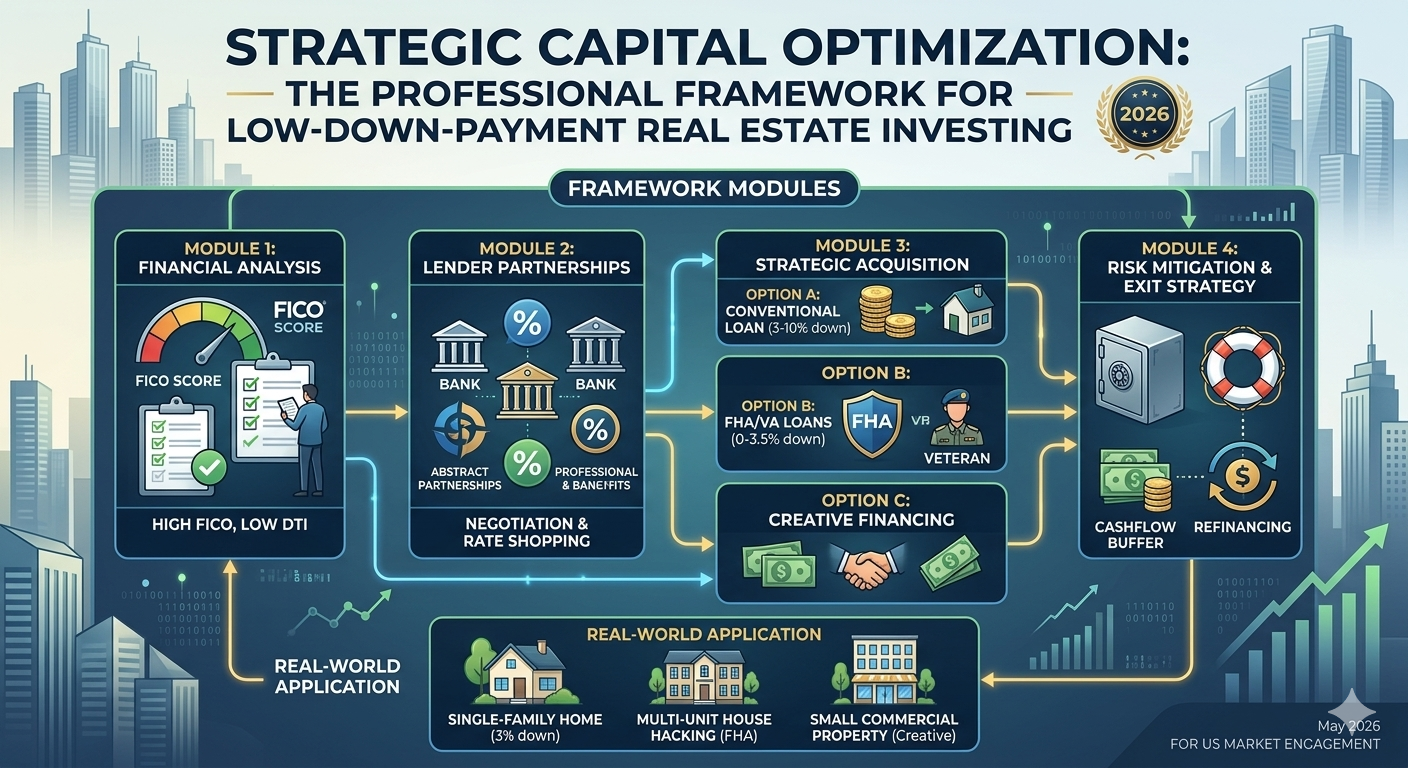
As of May 21, 2026, the American real estate landscape has entered a sophisticated “high-rate plateau,” where the average 30-year fixed mortgage rate hovers around 6.62%. For the professional investor, this environment demands a shift from the brute-force equity models of the past toward a more nuanced framework: Strategic Capital Optimization. This approach moves beyond the simple goal of “buying a property” and instead focuses on the surgical deployment of leverage to maximize cash-on-cash returns while preserving liquidity. In a market where the national median home price remains elevated, the ability to secure high-value assets with minimal upfront capital is no longer just a perk for first-time buyers—it is a core requirement for scaling a resilient portfolio.
The foundation of this professional framework begins with a deep understanding of the 2026 conforming loan limits. The Federal Housing Finance Agency (FHFA) recently increased the baseline conforming loan limit to $832,750, with high-cost areas reaching as high as $1,249,125. This adjustment is a critical lever for investors. By staying within these conforming boundaries, savvy operators can access conventional financing with down payments as low as 3% to 5%, provided the property serves as a primary residence for a portion of the hold period—a strategy often referred to as “house hacking” or “owner-occupant transition.” For those looking at multi-unit assets, the Federal Housing Administration (FHA) remains a powerhouse in 2026, offering a 3.5% down payment option for 1-4 unit properties, provided the floor limit of $541,287 or the local ceiling is respected.
However, the true hallmark of Strategic Capital Optimization in the current climate is the sophisticated use of Debt Service Coverage Ratio (DSCR) loans. As conventional lenders tighten their debt-to-income (DTI) requirements in response to 3.8% annual inflation, DSCR loans have become the primary vehicle for portfolio expansion. These products bypass personal income verification entirely, instead qualifying the loan based on the property’s ability to generate rental income. In May 2026, DSCR rates typically range between 6.5% and 8.5%, a premium worth paying for investors who prioritize speed and the ability to close in an LLC. While 20-25% down is standard for these products, the most competitive lenders are now offering 15% down options for properties with a DSCR of 1.25 or higher, allowing investors to keep more “dry powder” for future acquisitions.
The macro-economic backdrop of 2026 further supports this low-down-payment philosophy. Just yesterday, on May 20, 2026, the House of Representatives passed the 21st Century ROAD to Housing Act. This landmark legislation is designed to boost housing supply by increasing FHA-insured multifamily loan limits and removing the controversial “forced-sale” provisions that previously threatened institutional build-to-rent models. For the individual investor, this policy shift signals a long-term commitment to housing liquidity and supply growth, reducing the risk of a sudden market contraction. Furthermore, recent data from Realtor.com indicates that average down payments have hit a five-year low of 12.8%, suggesting that the market is finally tilting back toward buyers who can navigate these low-equity entries.
To execute this framework effectively, one must master the “break-even” math of 2026. With refinance rates sitting at 7.05%, the goal is not necessarily to find the lowest interest rate, but to find the highest yield relative to the capital deployed. Professional investors are increasingly using seller concessions—which have become more common as homes sit on the market for an average of six days longer than last year—to fund permanent rate buy-downs. This tactic allows an investor to enter a deal with a 3.5% or 5% down payment while effectively “fixing” the cash flow to mirror a much lower interest rate environment.
Ultimately, Strategic Capital Optimization is about agility. By utilizing the expanded 2026 loan limits and the flexibility of the ROAD to Housing Act’s new provisions, investors can control millions of dollars in real estate with a fraction of the traditional 20% equity requirement. In an era of geopolitical uncertainty and energy-driven inflation, liquidity is the ultimate hedge. Those who can master the art of the low-down-payment acquisition will find themselves perfectly positioned to capitalize on the next phase of the American real estate cycle, transforming market volatility into a structured engine for generational wealth.
Leave a Reply