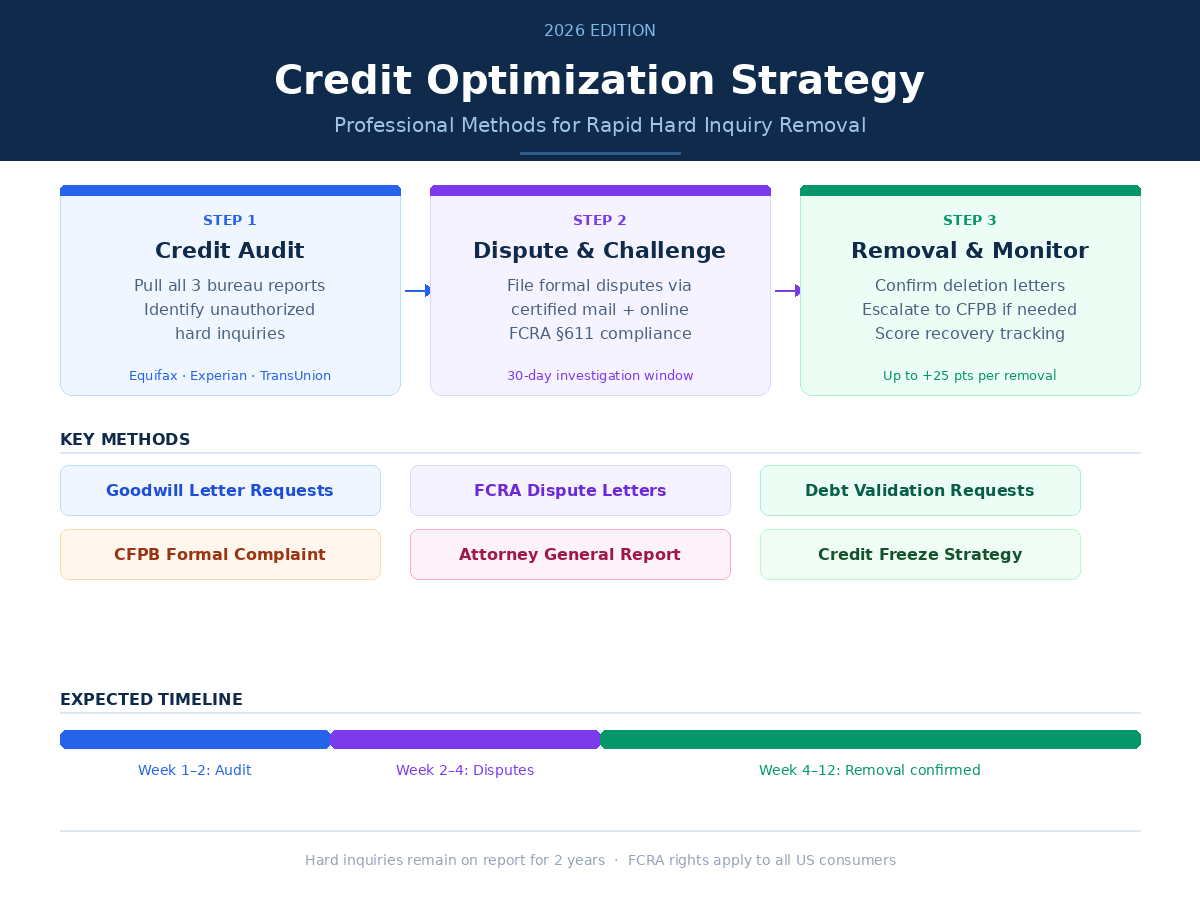
Navigating the American financial landscape in 2026 requires more than just paying bills on time; it demands a surgical approach to credit report maintenance. As we move further into this year, the impact of hard inquiries has become a focal point for savvy consumers looking to secure the best possible rates in a shifting economic environment. While a single hard pull might only nudge your score down by five to ten points, a cluster of them can signal “credit hunger” to modern algorithmic underwriting systems, potentially locking you out of premium credit products or the lowest mortgage tiers. Understanding how to professionally and rapidly address these marks is no longer a niche skill—it is a fundamental component of 2026 credit optimization.
The current regulatory environment has seen significant shifts that every US reader should note. With the full implementation of the Homebuyers Privacy Protection Act (HPPA) as of March 4, 2026, the era of “trigger leads” has largely ended. This landmark legislation now prohibits credit bureaus from selling your information to dozens of competing lenders the moment you apply for a mortgage, unless you explicitly opt-in. This change has naturally reduced the sheer volume of unsolicited inquiries, but it has also made the remaining unauthorized pulls stand out more starkly. Furthermore, while the Consumer Financial Protection Bureau (CFPB) has moved toward a more “statutory anchoring” approach under recent leadership, the core protections of the Fair Credit Reporting Act (FCRA) remain your most powerful weapon.
To begin a professional removal strategy, you must first secure the most authoritative data. In 2026, the federal allowance for free weekly credit reports through annualcreditreport.com remains in effect, providing a vital window into your files at Experian, Equifax, and TransUnion. Professional credit engineers emphasize that precision is the foundation of a successful dispute. You must identify inquiries that are truly unauthorized or inaccurate—those where no corresponding account was ever opened and no permission was granted. It is a common misconception that legitimate, authorized inquiries can be “wiped” easily; while some aggressive tactics exist, the most effective and legally sound professional methods focus on the “unverifiable” nature of questionable pulls.
One of the most effective “insider” strategies used by credit professionals today involves freezing secondary data bureaus before initiating a dispute with the Big Three. Companies like LexisNexis, SageStream (now part of Experian), and Innovis act as the “back-end” verification layers for the major bureaus. When you freeze these secondary reports, you effectively cut off the communication lines that Experian or TransUnion use to verify an inquiry’s legitimacy. Without the ability to cross-reference this data, the major bureaus often find themselves unable to verify the inquiry within the 30-day window mandated by FCRA Section 611, leading to a mandatory removal.
For those seeking “rapid” results—often defined in 2026 as removal within 7 to 14 days—the FTC-CFPB “Power Move” is the gold standard. This involves filing an official Identity Theft Report through identitytheft.gov. This isn’t just for cases of total account takeover; it is the appropriate venue for reporting any unauthorized use of your personal information to pull credit. Once you have this federal affidavit, you submit it to the CFPB’s complaint portal, specifically referencing FCRA Section 605B. This section of the law requires credit bureaus to block fraudulent information within four business days of receiving an identity theft report. While TransUnion often takes the full 30 days to process these, Experian and Equifax have been known to clear unauthorized inquiries in as little as a week when presented with a formal FTC affidavit.
If you are in an extreme rush—perhaps mid-way through a home purchase—the “Direct Call” tactic remains a viable professional method for Experian. By contacting their Special Services or Fraud department directly and providing your FTC report number, many consumers have seen unauthorized inquiries vanish within 24 to 48 hours. However, this requires a calm, professional demeanor and a clear paper trail. It is also important to remember that while inquiries stay visible for 24 months, their score impact in 2026 still typically expires after 12 months. Therefore, your optimization efforts should prioritize the most recent pulls, as these carry the heaviest weight in the eyes of FICO’s latest scoring models.
Ultimately, the 2026 strategy for hard inquiry removal is about leveraging federal law with surgical precision. By combining the protections of the HPPA, the verification-blocking power of secondary bureau freezes, and the rapid-response requirements of Section 605B, you can maintain a pristine credit profile that reflects your true creditworthiness. In an era where every basis point matters, taking control of your inquiry list is not just about “cleaning up” a report; it is about positioning yourself for maximum financial leverage in the American market.
Leave a Reply