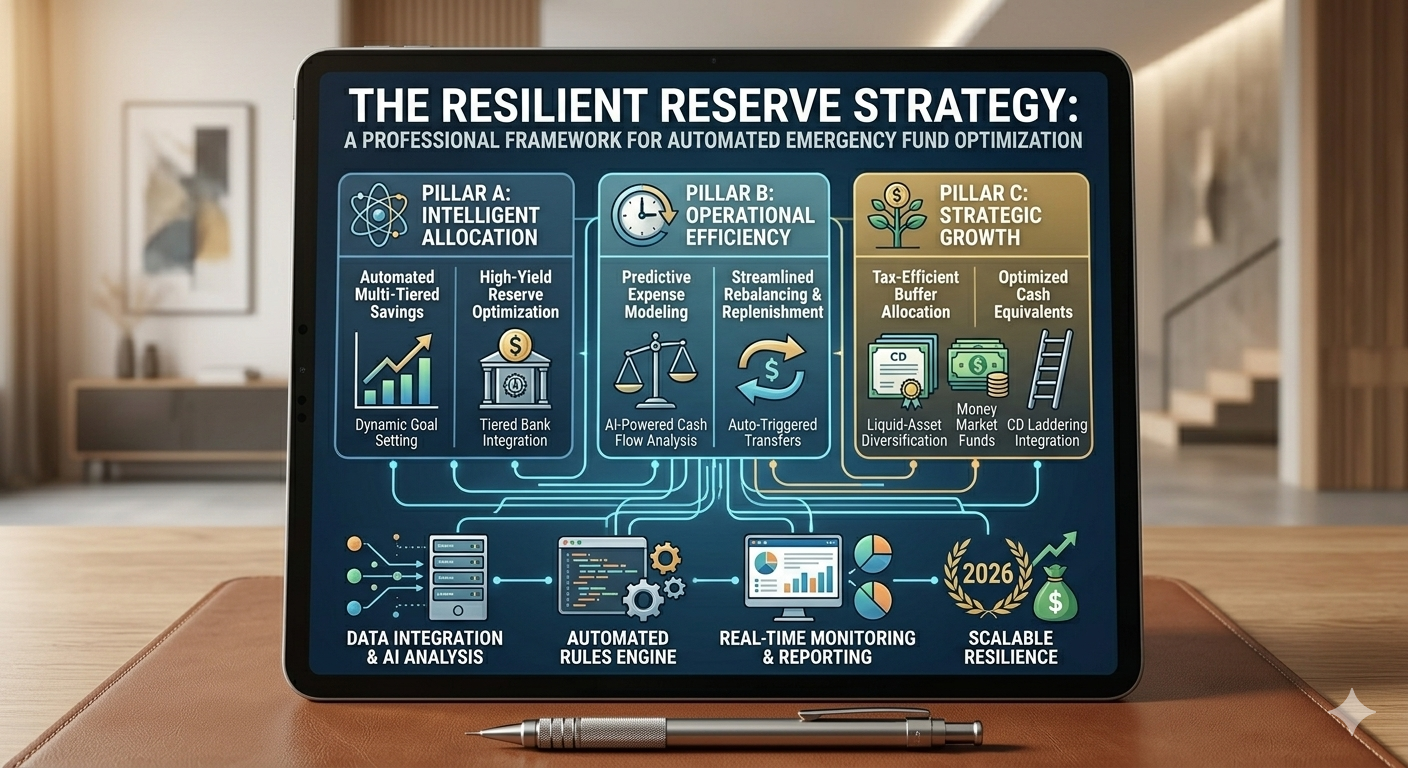
In the volatile economic landscape of May 2026, the traditional advice of stashing three to six months of expenses in a static savings account has become an outdated relic. With the Federal Reserve maintaining a “higher-for-longer” stance—holding the federal funds rate steady at 3.5 to 3.75 percent—and headline inflation recently spiking to 3.8 percent due to persistent energy shocks, the opportunity cost of idle cash has never been higher. To navigate this environment, sophisticated US savers are turning to the Resilient Reserve Strategy, a professional framework that leverages the latest in automated financial technology and the 2026 regulatory shift toward open banking to ensure every dollar of an emergency fund is working at its maximum potential.
The foundation of this strategy lies in dynamic liquidity management rather than fixed-sum hoarding. In an era where core PCE inflation is running at an annualized 4.3 percent, a stagnant emergency fund is effectively a leaking bucket. The Resilient Reserve Strategy replaces the “set it and forget it” mindset with an AI-driven sweep architecture. By utilizing the new Personal Financial Data Rights Rule that took effect for major US banks this April, savers can now grant secure, standardized access to their cash flow data to third-party optimization tools like Vera or Origin. These platforms use predictive algorithms to analyze your specific spending volatility, identifying the precise “safe-to-save” margin each week. Instead of a monthly manual transfer, funds are swept into high-yield environments in real-time, capturing the elevated yields currently offered by top-tier digital banks and money market funds which are still hovering near 5 percent.
Optimization in 2026 also requires a keen understanding of the “One Big Beautiful Bill Act” (OBBBA) and its impact on household liquidity. For instance, the 2026 tax year has introduced the “Trump account,” a specialized savings vehicle allowing up to $5,000 in annual contributions that can serve as a secondary tier of a family’s resilient reserve. Furthermore, with Health Savings Account (HSA) limits rising to $4,400 for individuals and $8,750 for families this year, the Resilient Reserve Strategy treats the HSA not just as a medical fund, but as a triple-tax-advantaged emergency tier for health-related shocks. By automating contributions to these specific buckets first, you create a multi-layered defense that protects your primary cash reserves from being depleted by predictable, yet irregular, expenses.
The “resilient” aspect of this framework refers to its ability to adapt to the “new normal” of 2026 borrowing costs. With 30-year mortgage rates projected to stay near 6.3 percent through the summer and credit card APRs remaining at historic highs, the cost of an unplanned debt spiral is catastrophic. A professional-grade automated reserve doesn’t just sit in a vault; it acts as a proactive buffer. Modern AI money coaches now offer “overdraft interception,” which uses real-time monitoring to move funds from your high-yield reserve back to your checking account 48 hours before a projected shortfall. This automated “self-lending” mechanism eliminates the risk of high-interest bridge loans or predatory fees, effectively turning your emergency fund into a private, interest-free credit line.
For US readers looking to implement this today, the first step is auditing your current banking stack for compatibility with the 2026 open banking standards. If your primary institution isn’t providing the API-level transparency required for these automated tools, the Resilient Reserve Strategy dictates a move to a more agile provider. In a market where the gap between a laggard national bank’s 0.01 percent interest and a fintech-driven 5.1 percent yield is wider than ever, the friction of switching is a small price to pay for long-term solvency. By integrating these automated sweeps, tax-advantaged buckets, and AI-driven forecasting, you aren’t just saving for a rainy day; you are building a sophisticated financial engine designed to thrive in an economy defined by high rates and rapid shifts. The Resilient Reserve Strategy ensures that while the market may be unpredictable, your financial foundation remains both automated and unshakeable.
Leave a Reply