• The 2026 Student Loan Refinancing Framework: Advanced Optimization Strategies for the Sophisticated Borrower

    The 2026 Student Loan Refinancing Framework: Advanced Optimization Strategies for the Sophisticated Borrower

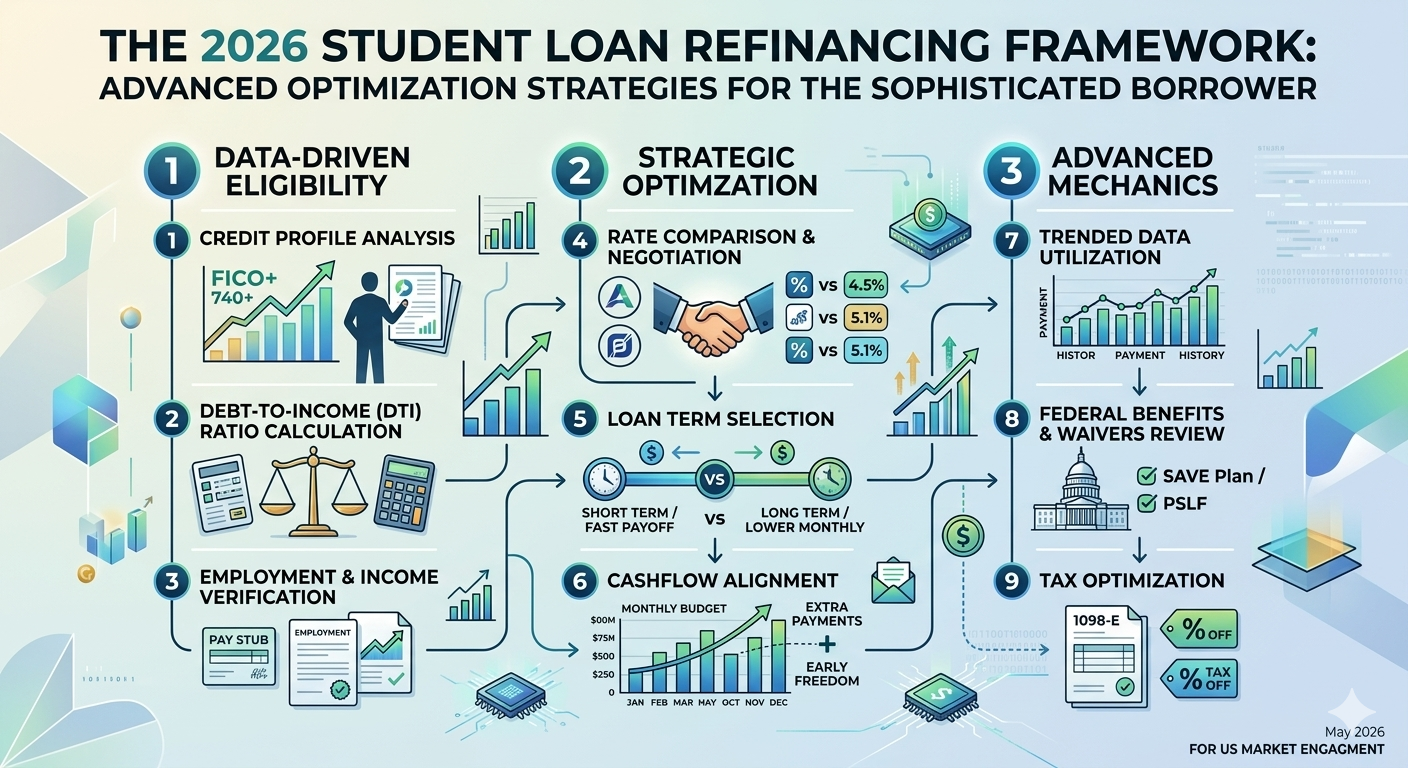
    As of May 21, 2026, the American student loan landscape has reached a critical inflection point, demanding a level of strategic rigor previously reserved for corporate debt restructuring. With the full implementation of the One Big Beautiful Bill Act (OBBBA) looming on July 1st, sophisticated borrowers are navigating a market defined by the sunsetting of the SAVE plan and the emergence of the Repayment Assistance Plan (RAP). This transition, coupled with a Federal Reserve that has maintained a “higher-for-longer” stance at 3.5–3.75% despite the inflationary pressures of the ongoing conflict in the Middle East, has created a unique arbitrage opportunity for those with high-tier credit profiles. The sophisticated borrower no longer views student debt as a static obligation but as a dynamic component of a broader capital allocation strategy.

    The current macro-environment presents a stark divergence between federal and private interest rates. While federal undergraduate rates for the 2025-2026 cycle sat at 6.39% and Graduate Direct Unsubsidized loans reached 7.94%, the private refinancing market has become aggressively competitive. Top-tier borrowers are currently seeing fixed-rate offers as low as 3.65%, creating an interest rate delta of over 400 basis points for graduate professionals. In a world where core PCE inflation has re-accelerated to 4.3% due to AI-driven hardware costs and energy volatility, locking in a private rate below the rate of inflation represents a significant “real” reduction in debt burden. However, the decision to refinance is no longer a simple mathematical exercise; it is a risk-adjusted trade-off against the thinning federal safety net.

    Under the OBBBA, the federal government is phasing out the Grad PLUS program and imposing strict lifetime borrowing caps, which has fundamentally altered the value of federal protections. For many, the new RAP plan—which replaces the more generous SAVE plan—offers a streamlined but potentially more expensive path to forgiveness. Sophisticated borrowers must now weigh the “insurance premium” of federal protections against the immediate liquidity gains of private refinancing. If your debt-to-income ratio is low and your career trajectory is stable, the 4% interest savings found in the private market often outweigh the value of a federal “safety net” that has become increasingly restrictive. This is particularly true for those in high-growth sectors like AI development or specialized medicine, where the probability of needing income-driven relief is statistically negligible.

    A key pillar of the 2026 framework is the “Grandfathering Hedge.” Borrowers who held federal loans prior to the July 1, 2026, deadline have a three-year window to continue borrowing under the old, higher limits or remain on legacy repayment plans. This creates a strategic “wait-and-see” period. The sophisticated approach involves maintaining federal status for the highest-interest tranches—such as Parent PLUS loans at 8.94%—while selectively refinancing lower-balance, high-rate graduate loans into the private market. By “laddering” your debt in this manner, you preserve the ability to access federal discharge programs for a portion of your portfolio while simultaneously reducing the weighted average cost of capital across your entire balance sheet.

    Furthermore, the 2026 borrower must consider the tax implications of employer-sponsored debt repayment. With Section 127 of the Internal Revenue Code now a permanent fixture of the corporate landscape, many sophisticated professionals are leveraging employer contributions as a “forced” principal reduction tool. When refinancing, it is essential to ensure that your private lender is integrated with your employer’s benefits platform. This allows for seamless, tax-free payments of up to $5,250 annually, which, when applied to a refinanced loan at 3.7%, accelerates the amortization schedule far more effectively than it would on a 7.9% federal loan.

    Optimization in 2026 also requires a sophisticated view of liquidity. With the U.S. economy bolstered by an AI-driven investment boom, the opportunity cost of over-paying student debt is at an all-time high. By refinancing to a lower monthly payment, borrowers can redirect the surplus cash flow into high-yield environments or tax-advantaged investment vehicles. In this framework, student loan refinancing is not just about “getting out of debt”; it is about maximizing your net worth by ensuring your cheapest capital is working the hardest.

    As we move toward the third quarter of 2026, the window for sub-4% private rates may begin to close if the Fed pivots toward a rate hike to combat sticky inflation. The sophisticated borrower should act before the July 1st regulatory shift complicates the underwriting process. By auditing your current portfolio against the 3.65% private
  • The 2026 Passive Income Framework: Professional Strategies for Beginner Wealth Optimization

    The 2026 Passive Income Framework: Professional Strategies for Beginner Wealth Optimization

    As of May 21, 2026, the landscape of American wealth building has shifted from the speculative frenzies of the early 2020s toward a more disciplined, policy-driven framework. For the modern beginner, optimizing wealth no longer means chasing the next viral digital asset; instead, it requires a professional-grade understanding of the current high-inflation environment and the specific tax advantages codified by recent legislation. With the Federal Reserve’s benchmark interest rate currently holding steady between 3.5% and 3.75%, and the newly sworn-in Fed Chair Kevin Warsh signaling a potential “policy firming” to combat a 6% surge in consumer price inflation, the 2026 framework for passive income is built on the pillars of tax-sheltered compounding and high-yield stability.

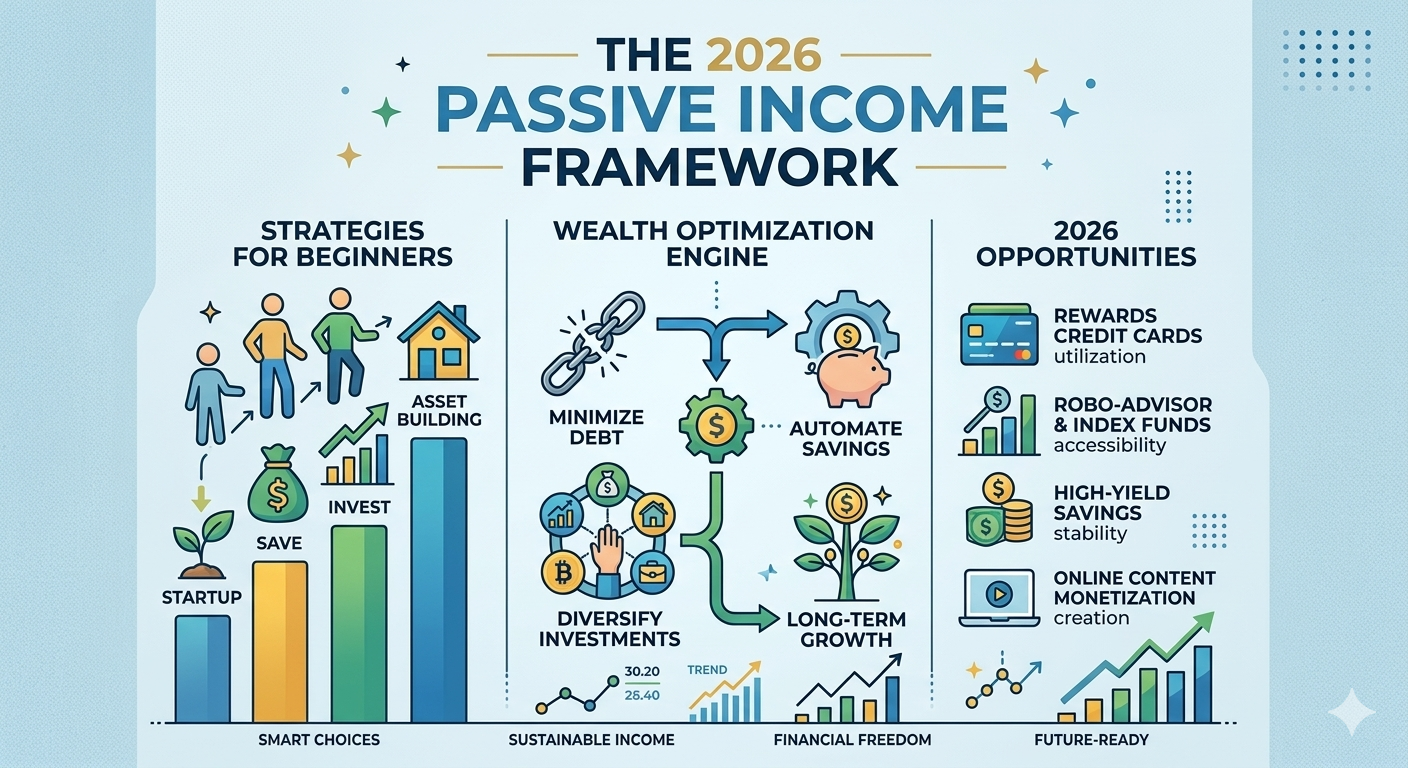
    The most accessible entry point for beginner wealth optimization this year lies within the updated Internal Revenue Service contribution limits. For the 2026 tax year, the IRS has increased the 401(k), 403(b), and most 457 plan elective deferral limits to $24,500, a significant jump that allows individuals to shield more of their primary income from the current 10% to 37% tax brackets. Furthermore, the Individual Retirement Account (IRA) limit has risen to $7,500. A critical professional strategy for 2026 involves navigating the new SECURE 2.0 requirements: if your prior-year wages exceeded $150,000, your catch-up contributions must now be made on a Roth basis. This shift toward after-tax contributions may seem like a hurdle, but for the long-term optimizer, it creates a powerful pool of tax-free liquidity that is essential for a diversified passive income portfolio.

    Beyond traditional retirement accounts, the real estate market in May 2026 offers a nuanced opportunity for those who can look past national headlines. While the average 30-year fixed mortgage rate remains elevated near 6.3%, the market is finally showing signs of “normalization” rather than a crash. Inventory levels have improved, and in tech-heavy corridors like Seattle and San Jose, property values are beginning to look undervalued relative to their long-term economic output. For beginners, the professional approach in 2026 is to utilize fractional ownership platforms or Real Estate Investment Trusts (REITs) that benefit from the 20% Qualified Business Income (QBI) deduction, which was recently made permanent under the One Big Beautiful Bill Act (OBBBA). This legislation has fundamentally changed the math for passive earners by stabilizing the tax treatment of pass-through income, making real estate-backed dividends more attractive than they were just two years ago.

    The current inflationary pressure, driven largely by energy shocks and global volatility, has also revitalized the “cash” component of a passive income strategy. In 2026, holding a portion of your wealth in high-yield savings accounts or short-term Certificates of Deposit (CDs) is no longer a defensive move—it is a yield-generating strategy. With many financial institutions offering guaranteed returns that rival the historical averages of the S&P 500, beginners can build a “liquidity ladder” that captures these higher rates while maintaining the flexibility to pivot as the Fed’s June meeting approaches. Professional wealth managers are currently emphasizing “portfolio resilience,” which means balancing these fixed-income yields against the rising cost of living.

    Tax efficiency is the final, often overlooked, component of the 2026 framework. The OBBBA has not only made the 2017 tax cuts permanent but has also introduced a new “bonus” deduction for seniors and expanded the standard deduction to $16,100 for single filers and $32,200 for those married filing jointly. For the beginner, this means that the first several thousand dollars of your passive income may effectively be tax-free. Additionally, the new $1,000 charitable deduction for non-itemizers allows you to offset gains while supporting community causes. By automating contributions to low-cost, dividend-paying ETFs and utilizing these new standard deduction thresholds, a beginner can achieve a level of wealth optimization that was previously reserved for high-net-worth individuals.

    Ultimately, the 2026 Passive Income Framework is about moving away from the “get rich quick” mentality and toward a “get rich surely” methodology. By maximizing the $24,500 401(k) limit, leveraging the permanent QBI deductions for real estate, and capturing the 3.75% yields available in the current rate environment, you are

  • The 2026 FICO 10T Framework: Strategic Methods for Trended Credit Score Optimization

    The 2026 FICO 10T Framework: Strategic Methods for Trended Credit Score Optimization

    The landscape of American consumer credit is undergoing its most significant transformation in decades. As of May 21, 2026, the shift from the traditional “snapshot” credit scoring model to the FICO 10T framework has moved from a theoretical update to an operational reality for millions of borrowers. For years, the industry relied on Classic FICO models that captured a single moment in time—a frozen image of your debt and payment status on the day your report was pulled. Today, the Federal Housing Finance Agency (FHFA) and the Department of Housing and Urban Development (HUD) have officially integrated FICO 10T and VantageScore 4.0 into the mortgage ecosystem, fundamentally changing how creditworthiness is defined. The “T” in FICO 10T stands for “Trended,” and understanding this shift is the key to optimizing your financial profile in this new era of lending.

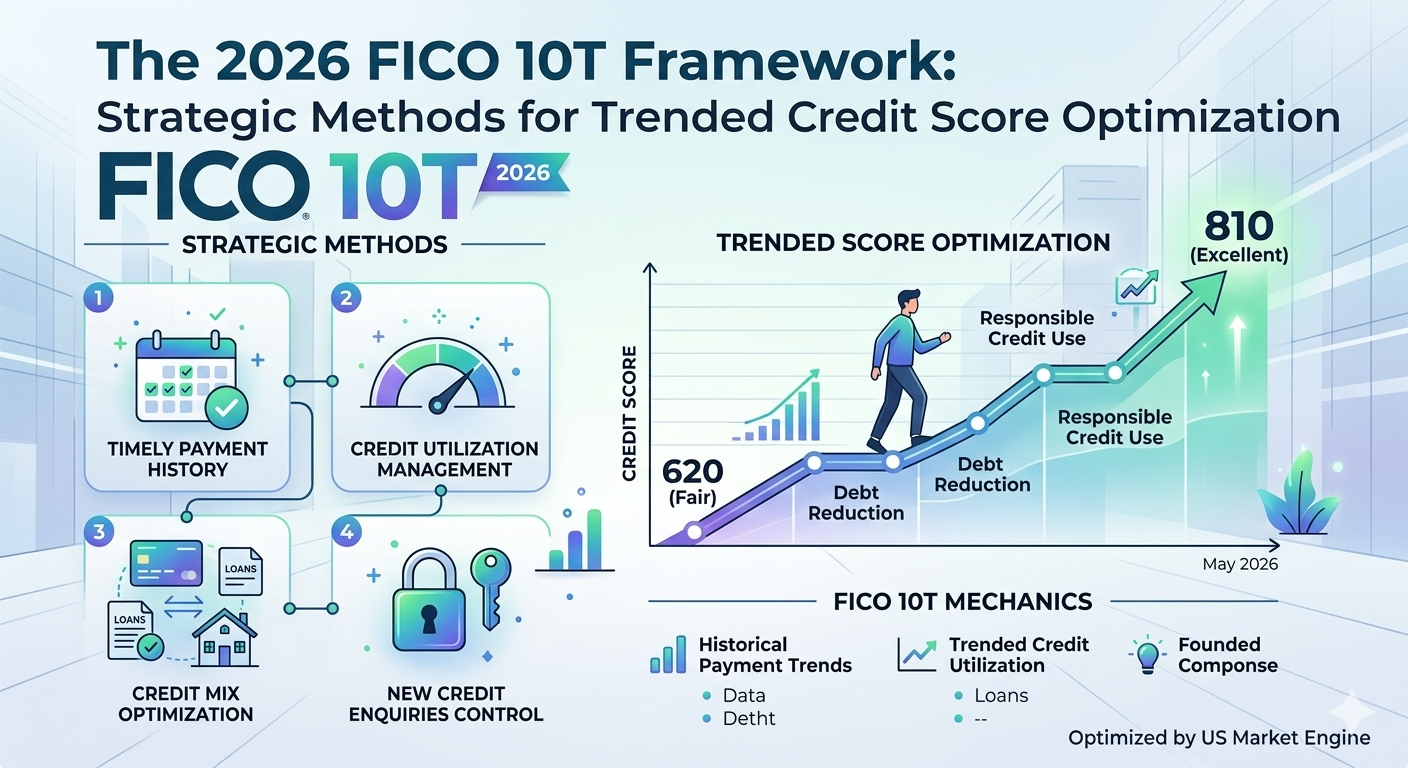
    Unlike its predecessors, the FICO 10T framework analyzes a 24-month rolling window of your financial behavior. This means that a one-time payment to lower your utilization right before applying for a loan—a common tactic in the “Classic” era—is no longer a silver bullet. Instead, the model distinguishes between “transactors,” who pay their balances in full every month, and “revolvers,” who carry debt from month to month. In the 2026 credit environment, being a transactor is the highest form of credit optimization. The trended data allows lenders to see if your debt levels are rising, falling, or remaining stagnant over two years. A borrower with a 720 score whose debt is trending downward is now viewed much more favorably than a borrower with the same score whose debt has been steadily climbing for eighteen months.

    Strategic optimization in 2026 requires a shift in focus toward long-term consistency. One of the most powerful levers in the FICO 10T model is the inclusion of alternative data, specifically rental and utility payment history. Following the regulatory updates earlier this spring, Fannie Mae and Freddie Mac have expanded their systems to reward consistent on-time rent payments, which were historically invisible to the major bureaus. If you are a renter, ensuring your landlord or property management company reports your data to the bureaus is no longer optional; it is a strategic necessity. For many “thin-file” borrowers, this data alone can provide the lift needed to qualify for competitive mortgage rates that were previously out of reach.

    Furthermore, the 2026 framework has finally integrated Buy Now, Pay Later (BNPL) data into the scoring mix. As these short-term installment loans became a staple of American retail over the last few years, their absence from credit reports created a blind spot for lenders. Now, every BNPL payment is a data point in your 24-month trend. To optimize your score, you must treat these small installments with the same gravity as a mortgage or auto loan. Stacking multiple BNPL plans can now signal “credit thirst” or financial instability, potentially dragging down your trended score even if you never miss a payment.

    The regulatory environment has also introduced new complexities regarding medical debt. While a 2025 CFPB initiative attempted to ban medical debt from reports entirely, recent federal court rulings in late 2025 and early 2026 have kept medical debts over $500 on the table in many jurisdictions. However, the FICO 10T model is designed to be more “forgiving” of these non-predictive dings compared to older models, focusing instead on your revolving credit trends. This is particularly relevant given that Fannie Mae recently eliminated its hard 620-score floor, moving toward a holistic risk assessment that weighs your cash reserves and debt-to-income ratio alongside your trended score.

    To master the FICO 10T framework, you must manage your credit as a trajectory rather than a destination. Avoid “credit cycling”—the practice of maxing out and paying off a card multiple times a month—as the trended data may flag this as high-risk behavior. Instead, aim for a steady, low utilization rate that remains consistent over the 24-month look-back period. As we approach the full phase-out of legacy models in 2027, the borrowers who thrive will be those who understand that their financial past is now a living part of their financial present. By maintaining a downward trend in revolving debt and ensuring all “alternative” payments like utilities and rent are documented, you can position yourself at the forefront of the 2026 credit market, unlocking lower interest rates and greater borrowing power in an increasingly sophisticated financial world.

  • The 2026 Credit Optimization Strategy: Professional Methods for Rapid Hard Inquiry Removal

    The 2026 Credit Optimization Strategy: Professional Methods for Rapid Hard Inquiry Removal

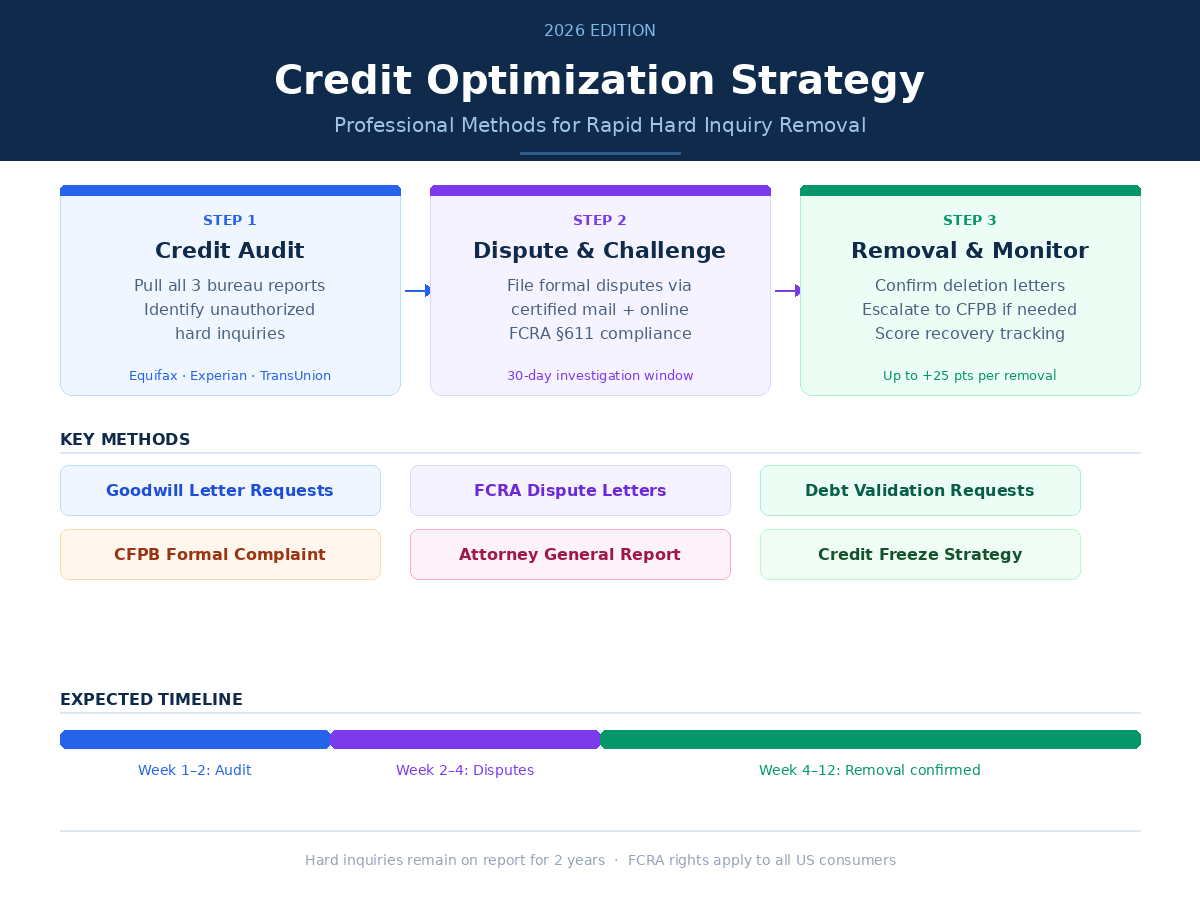
    Navigating the American financial landscape in 2026 requires more than just paying bills on time; it demands a surgical approach to credit report maintenance. As we move further into this year, the impact of hard inquiries has become a focal point for savvy consumers looking to secure the best possible rates in a shifting economic environment. While a single hard pull might only nudge your score down by five to ten points, a cluster of them can signal “credit hunger” to modern algorithmic underwriting systems, potentially locking you out of premium credit products or the lowest mortgage tiers. Understanding how to professionally and rapidly address these marks is no longer a niche skill—it is a fundamental component of 2026 credit optimization.

    The current regulatory environment has seen significant shifts that every US reader should note. With the full implementation of the Homebuyers Privacy Protection Act (HPPA) as of March 4, 2026, the era of “trigger leads” has largely ended. This landmark legislation now prohibits credit bureaus from selling your information to dozens of competing lenders the moment you apply for a mortgage, unless you explicitly opt-in. This change has naturally reduced the sheer volume of unsolicited inquiries, but it has also made the remaining unauthorized pulls stand out more starkly. Furthermore, while the Consumer Financial Protection Bureau (CFPB) has moved toward a more “statutory anchoring” approach under recent leadership, the core protections of the Fair Credit Reporting Act (FCRA) remain your most powerful weapon.

    To begin a professional removal strategy, you must first secure the most authoritative data. In 2026, the federal allowance for free weekly credit reports through annualcreditreport.com remains in effect, providing a vital window into your files at Experian, Equifax, and TransUnion. Professional credit engineers emphasize that precision is the foundation of a successful dispute. You must identify inquiries that are truly unauthorized or inaccurate—those where no corresponding account was ever opened and no permission was granted. It is a common misconception that legitimate, authorized inquiries can be “wiped” easily; while some aggressive tactics exist, the most effective and legally sound professional methods focus on the “unverifiable” nature of questionable pulls.

    One of the most effective “insider” strategies used by credit professionals today involves freezing secondary data bureaus before initiating a dispute with the Big Three. Companies like LexisNexis, SageStream (now part of Experian), and Innovis act as the “back-end” verification layers for the major bureaus. When you freeze these secondary reports, you effectively cut off the communication lines that Experian or TransUnion use to verify an inquiry’s legitimacy. Without the ability to cross-reference this data, the major bureaus often find themselves unable to verify the inquiry within the 30-day window mandated by FCRA Section 611, leading to a mandatory removal.

    For those seeking “rapid” results—often defined in 2026 as removal within 7 to 14 days—the FTC-CFPB “Power Move” is the gold standard. This involves filing an official Identity Theft Report through identitytheft.gov. This isn’t just for cases of total account takeover; it is the appropriate venue for reporting any unauthorized use of your personal information to pull credit. Once you have this federal affidavit, you submit it to the CFPB’s complaint portal, specifically referencing FCRA Section 605B. This section of the law requires credit bureaus to block fraudulent information within four business days of receiving an identity theft report. While TransUnion often takes the full 30 days to process these, Experian and Equifax have been known to clear unauthorized inquiries in as little as a week when presented with a formal FTC affidavit.

    If you are in an extreme rush—perhaps mid-way through a home purchase—the “Direct Call” tactic remains a viable professional method for Experian. By contacting their Special Services or Fraud department directly and providing your FTC report number, many consumers have seen unauthorized inquiries vanish within 24 to 48 hours. However, this requires a calm, professional demeanor and a clear paper trail. It is also important to remember that while inquiries stay visible for 24 months, their score impact in 2026 still typically expires after 12 months. Therefore, your optimization efforts should prioritize the most recent pulls, as these carry the heaviest weight in the eyes of FICO’s latest scoring models.

    Ultimately, the 2026 strategy for hard inquiry removal is about leveraging federal law with surgical precision. By combining the protections of the HPPA, the verification-blocking power of secondary bureau freezes, and the rapid-response requirements of Section 605B, you can maintain a pristine credit profile that reflects your true creditworthiness. In an era where every basis point matters, taking control of your inquiry list is not just about “cleaning up” a report; it is about positioning yourself for maximum financial leverage in the American market.